
You made the payment every month for years. Then one autopay lapsed after a servicer transfer, or the budget got tight for a quarter, and now your credit score has dropped further in a single month than it climbed in the previous two years. If you are searching for what student loan late payments do to your credit score, you are not alone — delinquency reporting has resumed at full force and millions of borrowers are seeing the damage on their reports for the first time.
The good news: the reporting timeline is slower than most people assume, and almost every stage of it has an escape hatch. This guide walks through what happens, when, and exactly what to do at each point.
Why This Matters Right Now
Student debt is the second-largest category of household debt in the United States after mortgages, and it touches roughly one in eight adults. For most borrowers it is also the oldest installment account on their credit file — which means it carries outsized weight in two scoring factors at once: payment history (about 35% of a FICO score) and length of credit history (about 15%).
When that account goes delinquent, the damage is not cosmetic. Borrowers report losing mortgage pre-approvals, seeing auto loan rates jump several percentage points, and being denied apartment applications, all from a single reported late payment on an account they fully intend to repay.
Background: How Student Loan Delinquency Actually Works
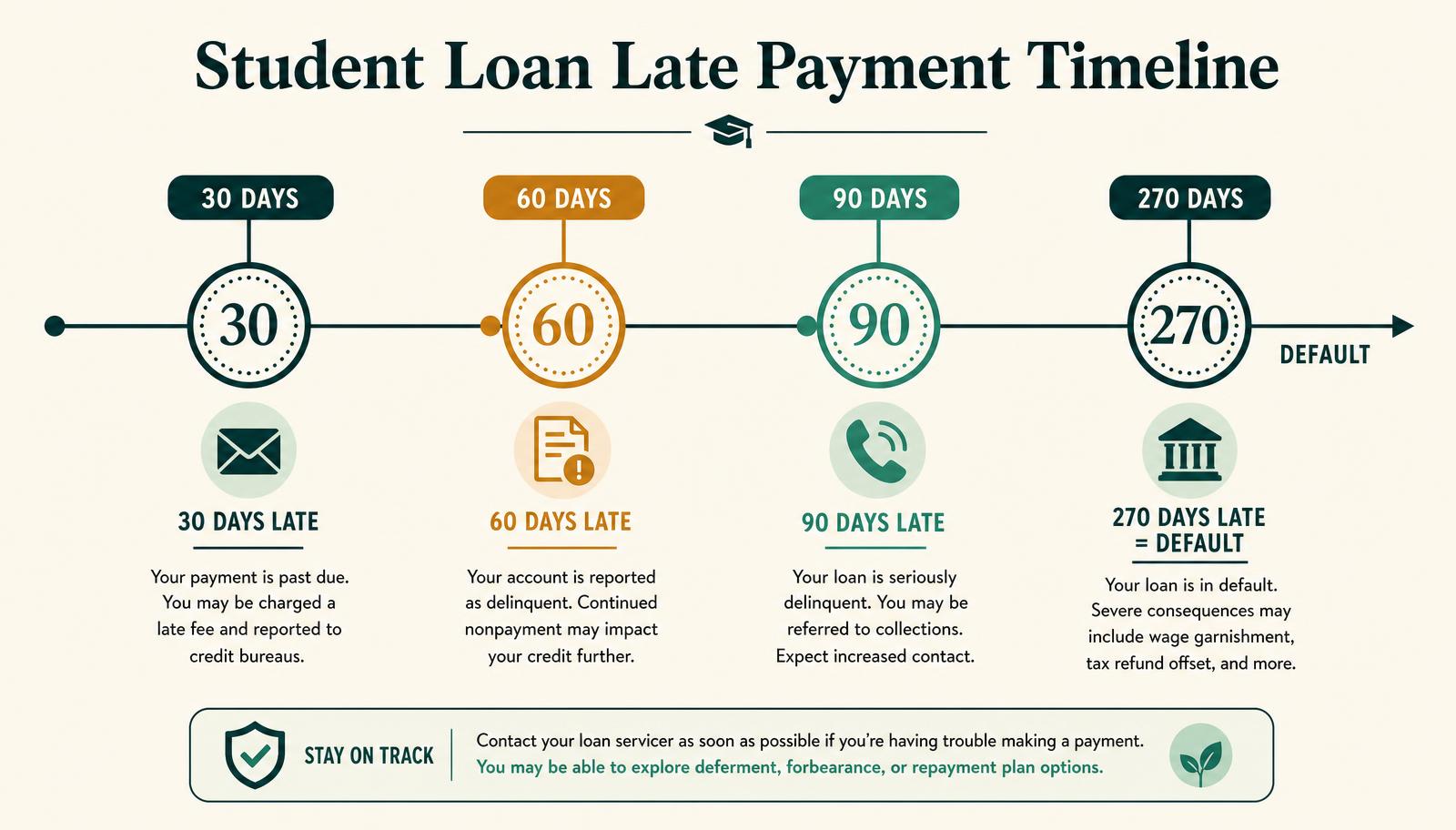
Unlike a credit card, which can be reported late at 30 days, federal student loans follow a longer and more forgiving schedule.
Day 1–29: Past due, nothing reported
Your payment is late. The servicer will email or call. Nothing has reached Equifax, Experian or TransUnion. Fixing it here costs you nothing but the payment itself.
Day 30–89: Delinquent, still unreported
The account is formally delinquent. Late fees may apply on private loans; federal loans typically do not charge them at this stage. Crucially, the bureaus still have not been told. This is the most valuable and most wasted window in the entire process.
Day 90: The delinquency is reported
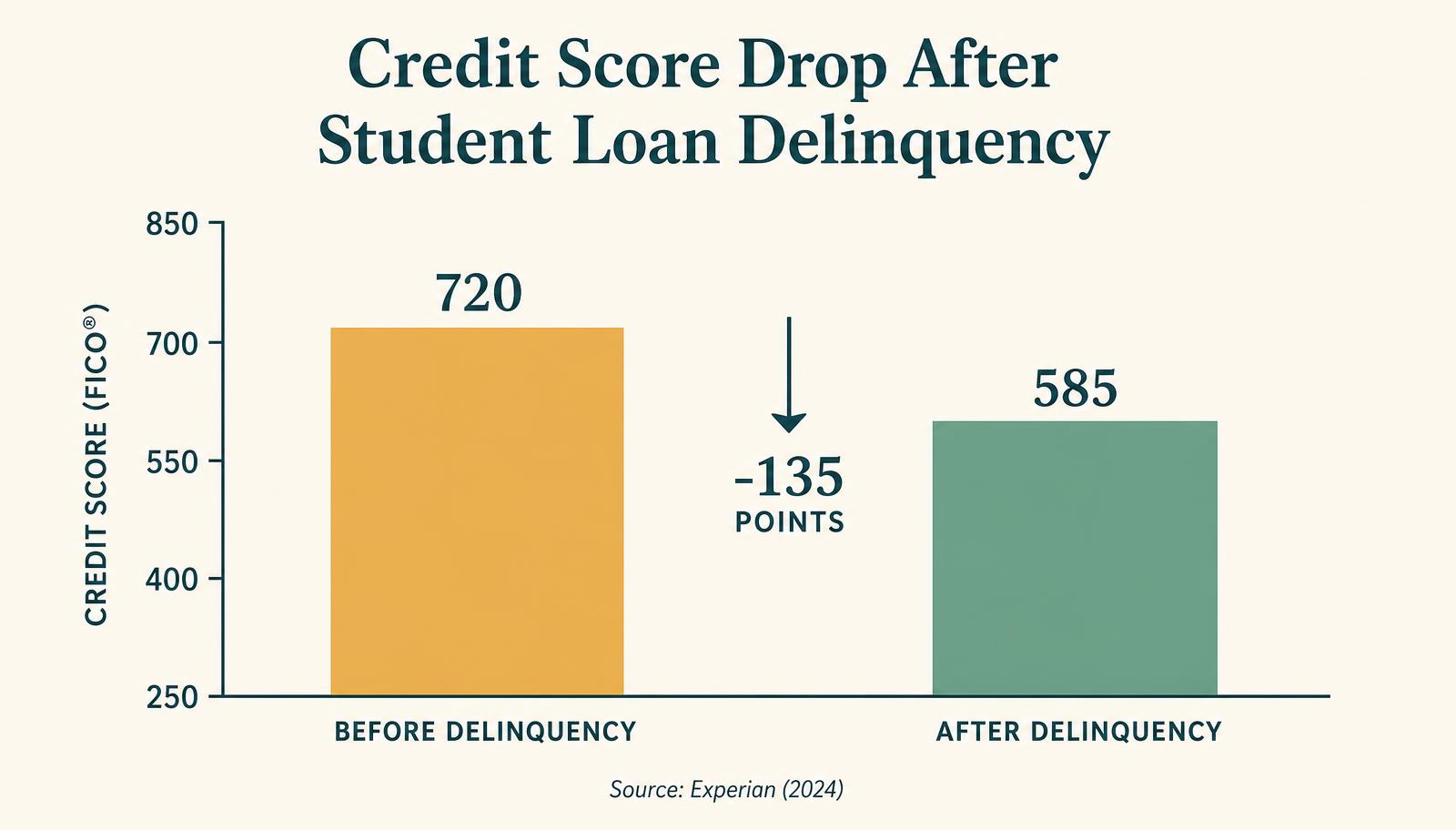
At 90 days past due, the servicer reports the delinquency to all three national credit bureaus. This is the moment the score drops. The entry stays on your credit report for seven years from the date of the delinquency, even after you bring the loan current.
Day 270: Federal default
For most federal loans, default arrives at 270 days past due. The consequences escalate sharply: the full balance can be accelerated, collection costs can be added, and the government can garnish wages, offset tax refunds, and withhold portions of Social Security benefits — all without a court judgment.
Private loans move faster. Many private lenders declare default at 90 to 120 days and pursue a court judgment, which then appears as a public record and can lead to a collection account on your credit report.
Key Facts and Data
- Payment history is roughly 35% of a FICO score — the single largest factor.
- A reported delinquency remains for seven years from the delinquency date.
- Higher scores fall further: a borrower near 760 typically loses far more points than one near 600, because the model has more risk-free assumption to unwind.
- Delinquencies age. The scoring impact of a late payment is heaviest in the first 12 months and fades meaningfully after 24 months of clean history.
- Federal default at 270 days can trigger administrative wage garnishment and Treasury offset.
Step 1: Confirm What Is Actually Being Reported
Before you negotiate anything, get the facts. Pull all three reports free from AnnualCreditReport.com, the only federally authorized source, and check each student loan tradeline for:
- The reported status. Current, 90 days late, 120 days late, default.
- The date of first delinquency. This starts the seven-year clock and cannot legally be re-aged.
- The balance and servicer name. Servicer transfers are the single most common cause of accidental delinquency, and they are also a common cause of duplicate or wrong reporting.
- Duplicate tradelines. A transferred loan should show the old account as transferred or closed, not as a second active delinquent balance.
Errors here are common. If something is wrong, dispute it — our walkthrough on how to fix errors on your credit report covers the letter format and the 30-day investigation window the bureaus are required to honor.
Step 2: Get the Loan Out of Delinquency
If the late payment has not yet hit 90 days, everything below can prevent it from ever being reported.
Option A: Pay the past-due amount
The simplest fix. Call the servicer and confirm the exact amount required to bring the loan current, then get written confirmation the account is reported as current.
Option B: Switch to income-driven repayment
Federal income-driven repayment plans recalculate your monthly payment based on discretionary income and family size. For many borrowers the recalculated payment is dramatically lower, and for low-income borrowers it can legally be $0 per month — a payment that is still reported as on time. Applications are free at StudentAid.gov; no company should ever charge you to file one.
Option C: Deferment or forbearance
A temporary pause. Deferment is generally better than forbearance because subsidized loans do not accrue interest during it. Both keep the account out of delinquency, but interest capitalization can raise your balance, so treat them as short-term tools rather than a plan.

Option D: Loan rehabilitation (if already in default)
For federal loans in default, rehabilitation typically requires nine reasonable, affordable monthly payments within ten months. On completion, the default notation is removed from your credit report — one of the few times a serious negative can be erased by performance rather than dispute. The individual late payments that preceded the default remain, but the default itself comes off.
Step 3: Ask for a Goodwill Adjustment
If the delinquency was already reported and it is accurate, you have one strong free option left: a goodwill adjustment letter asking the servicer to remove the late notation as a courtesy.
It works best when you can say, honestly:
- This was a first and isolated late payment on the account.
- There was a specific cause: a servicer transfer, a job loss, a medical event, a failed autopay.
- The account is now current and enrolled in autopay.
- You have an otherwise clean multi-year history with them.
Keep it to one page, unemotional, and specific. Send it to the servicer's written correspondence address, not a call center chat. Success is not guaranteed — it is discretionary — but it costs a stamp and it works often enough to be the first thing you try.
Step 4: Rebuild the Score Around the Scar
A reported late payment will not disappear on request. What you can control is everything surrounding it.
- Automate every payment. Autopay on every account, plus a calendar alert two days before each due date as a backup for failed drafts.
- Drive utilization down. Revolving balances are the fastest-moving lever you have. Our credit utilization guide explains why the popular 30% rule is set too high.
- Add positive tradelines. Rent payments and small installment accounts add on-time history. See rent reporting for a low-cost route.
- Do not close old accounts. Age of history matters, especially when your oldest account just took damage.
- Check quarterly. Confirm the servicer stops reporting new lates the moment you are current again.

Real-World Impact
The consequences reach well beyond a number in an app.
- Mortgages. Lenders price loans in score tiers. Dropping from 740 to 640 can move a rate by a full percentage point or more, which on a 30-year loan is tens of thousands of dollars.
- Auto loans. Subprime auto pricing is brutal; the same car can cost thousands more in interest.
- Housing and utilities. Landlords and utility providers routinely screen credit and require larger deposits after a delinquency.
- Employment. Some employers in finance and government run credit checks for specific roles.
- Compounding stress. Higher borrowing costs shrink the budget that would have prevented the missed payment in the first place.
Expert Perspective
Consumer advocates consistently make the same two points. First, the reporting window is longer than borrowers think — most people who lose 100 points had a full 89 days in which a five-minute phone call would have prevented it. Second, nearly every legitimate remedy is free. The Consumer Financial Protection Bureau's student loan guidance and the Department of Education's own portal handle every application at no cost. Any company charging a fee to enroll you in an income-driven plan is selling you a free form.
Quick Summary
- Nothing is reported until 90 days past due. Act inside that window.
- Federal default arrives at 270 days and unlocks garnishment and offset.
- Income-driven repayment can lower a federal payment to $0 and still count as on time.
- Rehabilitation removes the default notation from your report.
- Goodwill letters remove first-time lates more often than borrowers expect.
- Rebuild around the scar with utilization, automation and new positive history.
Conclusion and Outlook
Student loan delinquency is one of the few credit problems where the system genuinely gives you time — three months of it before anything is reported, and nine more before default. The borrowers who get hurt are almost never the ones who could not pay. They are the ones who did not open the servicer's mail.
Pull your three reports this week, confirm what is actually being reported, and if you are behind, make the call today rather than next month. Then keep going: our fast-track guide to improving your credit score covers what to do once the bleeding stops.
Found this useful? Share it with someone who just got a servicer letter, and grab the Honest Credit Rebuild Blueprint — currently 40% off — for the full step-by-step recovery system.