
You open the mailbox and there it is: a collection notice for a debt you half-forgot, or never recognized at all. Then the mortgage pre-approval comes back weaker than expected, or the apartment application asks for an extra deposit. A single collection account can quietly reshape your finances for years.
The good news is that how to remove collections from your credit report is not a mystery, and it is not something you need to pay a credit repair company hundreds of dollars to attempt. Every legal tool available to those companies is available to you for free. This guide walks the exact order to use them in.
Why Collections Hit So Hard
Payment history is roughly 35% of your FICO score, and a collection is the loudest possible negative entry inside it. It tells lenders that a debt went unpaid long enough for the original creditor to give up.
The damage varies with your starting point. Someone at 780 can lose 100+ points from a single collection; someone at 580 may lose 40 because the damage is already priced in. Either way, collections tend to be the item that keeps applications in the "declined" pile long after balances are paid down.
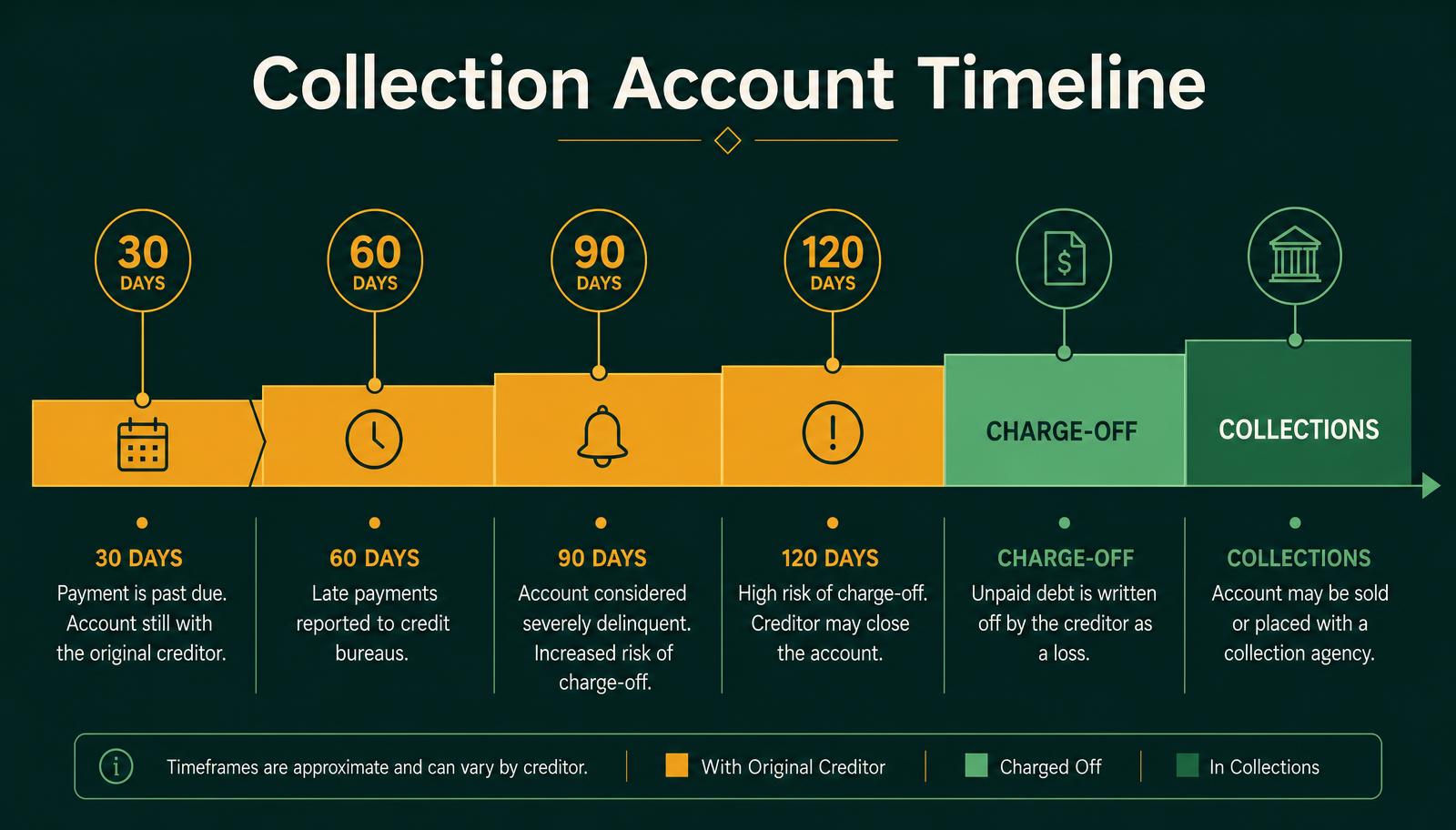
Background: How a Debt Ends Up in Collections
Understanding the pipeline tells you who you are actually negotiating with.
- 30-120 days late. The original creditor reports late payments each cycle. The account is still theirs.
- Charge-off (usually ~180 days). The creditor writes the debt off as a loss for accounting purposes. You still owe it.
- Assigned or sold. The creditor either hires an agency on commission or sells the debt outright to a debt buyer, sometimes for pennies on the dollar.
- A second tradeline appears. The collection shows up as its own entry, separate from the original account. Both can appear on your report at once.
That last point matters: a debt buyer who paid four cents on the dollar has enormous room to negotiate. A first-party agency working on commission has less.
Step 1: Pull All Three Credit Reports First
Never work from a collector's letter alone. Pull your Equifax, Experian and TransUnion reports directly from AnnualCreditReport.com, the only federally authorized source, and read each collection entry closely.
Write down, for every collection:
- The collection agency name and the original creditor
- The reported balance
- The date of first delinquency
- Which bureaus show it (frequently not all three)
Discrepancies between the three reports are leverage. Our walkthrough on how to fix errors on your credit report covers the dispute mechanics in detail.
Step 2: Demand Validation Before You Pay Anything
Under the Fair Debt Collection Practices Act, you have 30 days from a collector's first written contact to request validation of the debt. Send the request by certified mail with return receipt.

Your letter should ask the collector to provide:
- Proof that the debt is yours, with the original account number
- An itemized balance including any added fees or interest
- Evidence that the agency owns or is authorized to collect the debt
- Their license to collect in your state, where applicable
Until the collector validates, it must stop collection activity. And here is the practical reality: debts sold two or three times often arrive with almost no documentation. A collector who cannot validate frequently deletes the tradeline rather than fight it.
Do not admit the debt is yours in this letter. Keep it procedural. Never make a "good faith" payment before validation — in many states, a partial payment restarts the statute of limitations on an old debt.
Step 3: Dispute Anything Inaccurate
Roughly one in three collection tradelines contains at least one error. Common ones:
- Wrong balance or a balance inflated with unauthorized fees
- Wrong original creditor
- Duplicate reporting — the same debt listed by two agencies at once
- A re-aged date of first delinquency, which illegally extends the seven-year clock
- A debt already discharged in bankruptcy
- Simple identity mix-ups with a relative or a similar name
File the dispute with each bureau reporting the error. They have 30 days to investigate. If the collector cannot verify, the entry must be deleted. Dispute in writing rather than through a mobile app when the case is detailed — a paper trail helps if you need to escalate to the CFPB complaint database.
Step 4: Know What Paying Actually Does
This is where most advice goes wrong, because the answer depends on the scoring model.
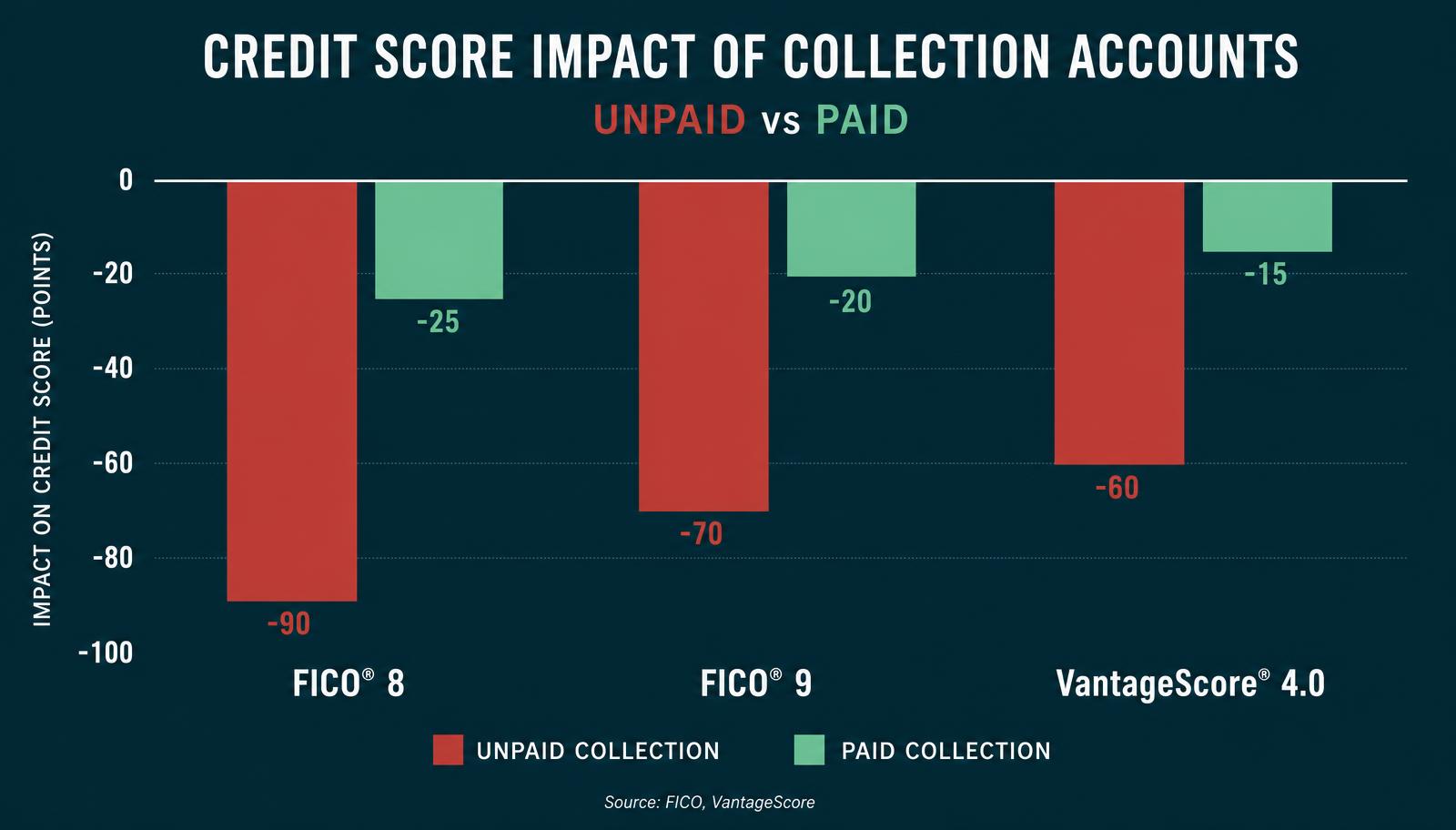
- FICO 8 — still the most widely used model. Ignores whether a collection is paid. Paying does not raise your score under FICO 8, though it does remove the balance from lender manual reviews.
- FICO 9, FICO 10T and VantageScore 4.0 — ignore paid collections entirely. Paying can produce a large jump.
- Mortgage models (FICO 2/4/5) — older still, but most underwriters require collections resolved before closing regardless of score.
So paying is rarely a waste, and it is usually mandatory before a mortgage. It is simply not the instant score fix people expect under FICO 8.
Special case: medical collections. These now follow separate rules, including reporting delays and thresholds under which paid or small balances should not appear at all. If your collection is medical, read our dedicated guide on medical debt and your credit report before paying a cent.
Step 5: Negotiate — Pay-for-Delete or Settlement
If the debt is genuinely yours and validated, negotiation is the next lever.

How to run the call:
- Open low. Offer 25-40% of the balance on a debt-buyer account. Many were bought for less than ten cents on the dollar.
- Ask for deletion in writing. Say plainly: "I can pay this today if you agree in writing to request deletion of the tradeline from all three bureaus." Some agencies refuse on policy grounds; many do not.
- If deletion is refused, get "paid in full" status rather than "settled for less," which reads better to a human underwriter.
- Never give bank access over the phone. Pay by cashier's check or a one-time method after the written agreement arrives.
- Keep every document for seven years. Zombie debt resurfaces.
Watch the statute of limitations in your state — typically three to six years. Once it passes, the debt is time-barred and cannot be sued over, though it can still be reported until the seven-year mark. Making a payment on a time-barred debt can revive the right to sue you. Confirm the date before you negotiate.
Step 6: Goodwill Requests for Paid Accounts
If the collection is already paid, a goodwill letter costs nothing. Write to the collector or original creditor, explain the circumstances honestly — job loss, illness, a genuine mistake — note your subsequent clean history, and politely ask them to remove the entry as a courtesy.
Success rates are modest, and higher with original creditors than with debt buyers. But a short, sincere, one-page letter has removed entries that survived three disputes.
Step 7: Rebuild Around the Damage
While the collection ages, your job is to make everything around it look excellent:
- Keep every current account 100% on time — the strongest signal you can send.
- Push revolving balances low; our guide to credit utilization explains why under 10% beats the old 30% rule.
- Add positive tradelines. A secured card or credit-builder loan starts a fresh, clean history.
- Follow the sequencing in our fast-track score guide so each move compounds.
A collection from 2021 with three years of flawless behavior behind it is a very different underwriting story than a collection with nothing after it.
Mistakes That Make Collections Worse
- Paying instantly to make it go away. You lose validation rights and negotiating leverage the moment you pay.
- Disputing accurate debts repeatedly. Frivolous disputes get flagged and waste your credibility.
- Paying a debt buyer without written terms. Verbal deletion promises evaporate.
- Hiring a repair company that charges up front. Advance fees are illegal for credit repair organizations under federal law.
- Ignoring a lawsuit summons. A default judgment is far worse than the collection itself.
Quick Summary
- Pull all three reports and catalogue every collection detail.
- Demand validation in writing within 30 days — before paying.
- Dispute inaccuracies; unverifiable entries must be deleted.
- Understand that paying helps under newer models and is required for mortgages.
- Negotiate for deletion, always in writing, and never restart the statute of limitations.
- Rebuild aggressively so the collection ages against a clean record.
Conclusion and Outlook
Collections feel permanent. They are not. Between validation rights, dispute rights, the seven-year clock, and scoring models that increasingly ignore paid collections, the direction of travel is firmly in the consumer's favor. The people who remove collections successfully are simply the ones who follow the sequence — validate, verify, dispute, negotiate — instead of panicking and paying.
Start with your three reports this week. One letter, sent certified, is often all it takes to begin.
Want the complete letter templates and negotiation scripts? The Honest Credit Rebuild Blueprint walks you through every stage of the process, and it is currently 40% off.