Millions of Americans went to bed in early 2026 believing their medical debt was about to disappear from their credit reports for good. Then the courts intervened. The federal rule that would have stripped roughly $49 billion in medical collections from about 15 million credit files was vacated, and what stands between a single emergency room visit and a wrecked credit score is now something far more fragile: a voluntary policy the credit bureaus can change whenever they choose.
If you have ever been surprised by a hospital bill, the medical debt credit report rules of 2026 matter to you right now. This guide explains exactly what changed, what still protects you, and the practical steps that keep a medical bill from becoming a seven-year stain on your credit history.

Why Medical Debt on Credit Reports Is Suddenly Front-Page News
Medical debt is unlike almost every other kind of debt. Nobody plans an appendectomy. Nobody comparison-shops an ambulance ride. And yet, for decades, an unpaid balance from a hospital was treated by credit scoring models exactly the same way as a maxed-out credit card or a defaulted auto loan.
Three things collided to put this back in the headlines:
- The federal rule was struck down. A federal court vacated the Consumer Financial Protection Bureau rule that would have banned medical debt from consumer credit reports outright, leaving no binding national protection.
- The dollars are enormous. An estimated $49 billion in medical collections across roughly 15 million consumer files was set to vanish automatically. It did not.
- State law is now a patchwork. A growing number of states have passed their own medical debt reporting restrictions, so your protection increasingly depends on where you live.
The result is one of the most confusing moments in modern consumer credit. Headlines from 2024 and 2025 told people medical debt no longer counts. In 2026, that is only partly true — and the difference can be worth 80 to 100 points on your score.
What Still Protects You: The Voluntary Bureau Policy
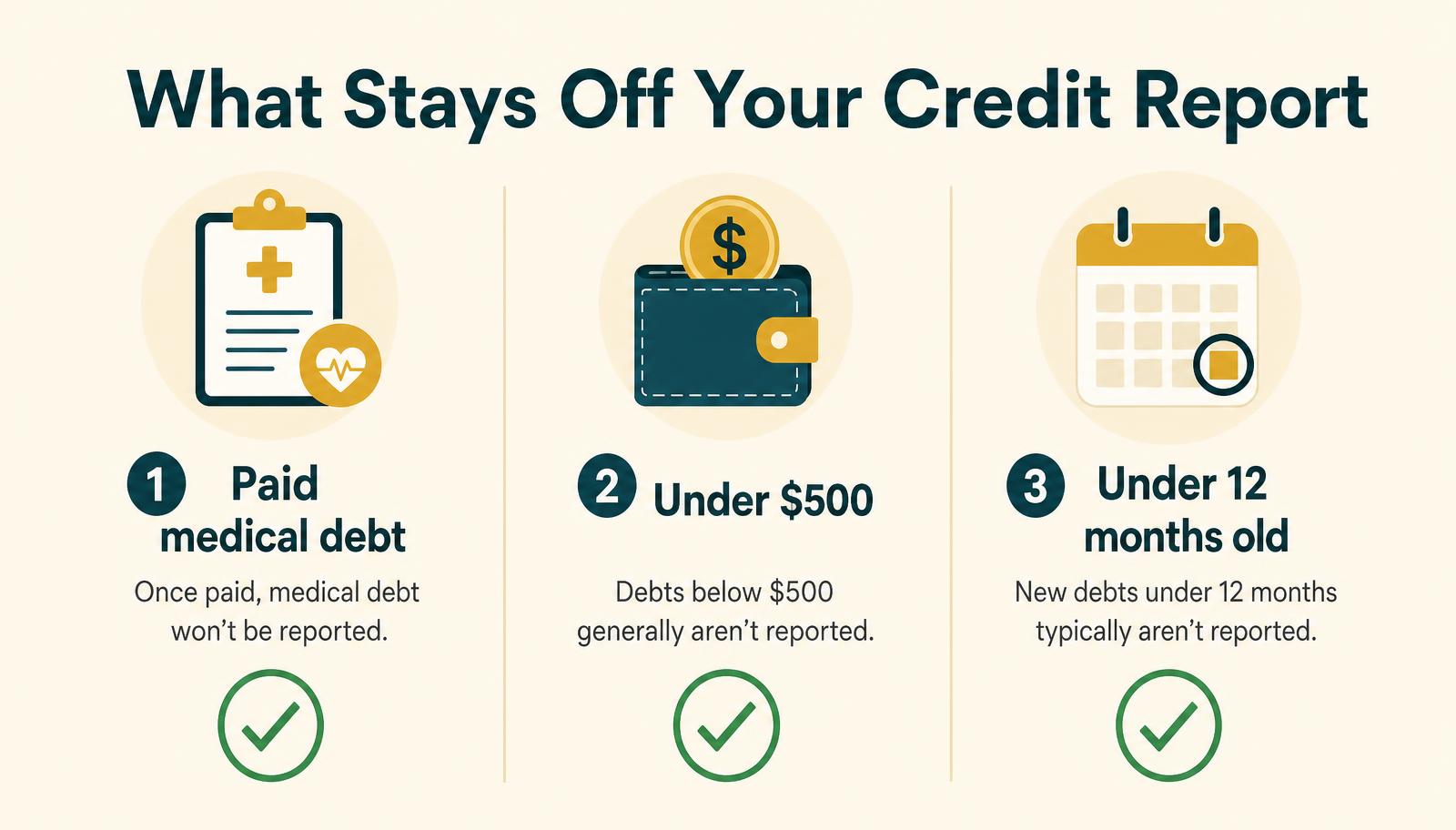
Beginning in 2022 and 2023, Equifax, Experian, and TransUnion adopted a set of voluntary changes that they have kept in place. These are the protections that survived the court decision.
1. Paid Medical Collections Are Removed
Once you pay a medical collection in full, it should come off your consumer credit report entirely — not sit there marked "paid" for seven years the way other collections do. This is the single most valuable protection on the list, because it turns paying a medical bill into a direct score repair action.
2. Unpaid Balances Under $500 Are Excluded
Small medical collections below the $500 threshold are not reported at all. Since a large share of medical collections are small-dollar items, this quietly removed tens of millions of tradelines from consumer files.
3. A 12-Month Grace Period
Medical debt less than one year old is kept off your report. That window exists for a reason: medical billing is slow, insurance appeals take months, and a bill sitting in dispute is not the same thing as a bill you refused to pay. Use that year.
What Is Not Protected
Anything that falls outside those three buckets can still be reported and can still hurt you:
- Unpaid medical collections of $500 or more that are older than 12 months
- Medical debt you moved onto a credit card, personal loan, or medical credit line — once it is consumer credit, it is treated as ordinary debt with no medical protections
- Medical bills that went to a court judgment, depending on your state
- Debt reported to business credit files rather than consumer files
That last point catches people constantly. Financing an $8,000 procedure with a medical credit card feels responsible, but it converts protected medical debt into unprotected revolving debt that also spikes your credit utilization.
How Much Does a Medical Collection Actually Cost Your Score?
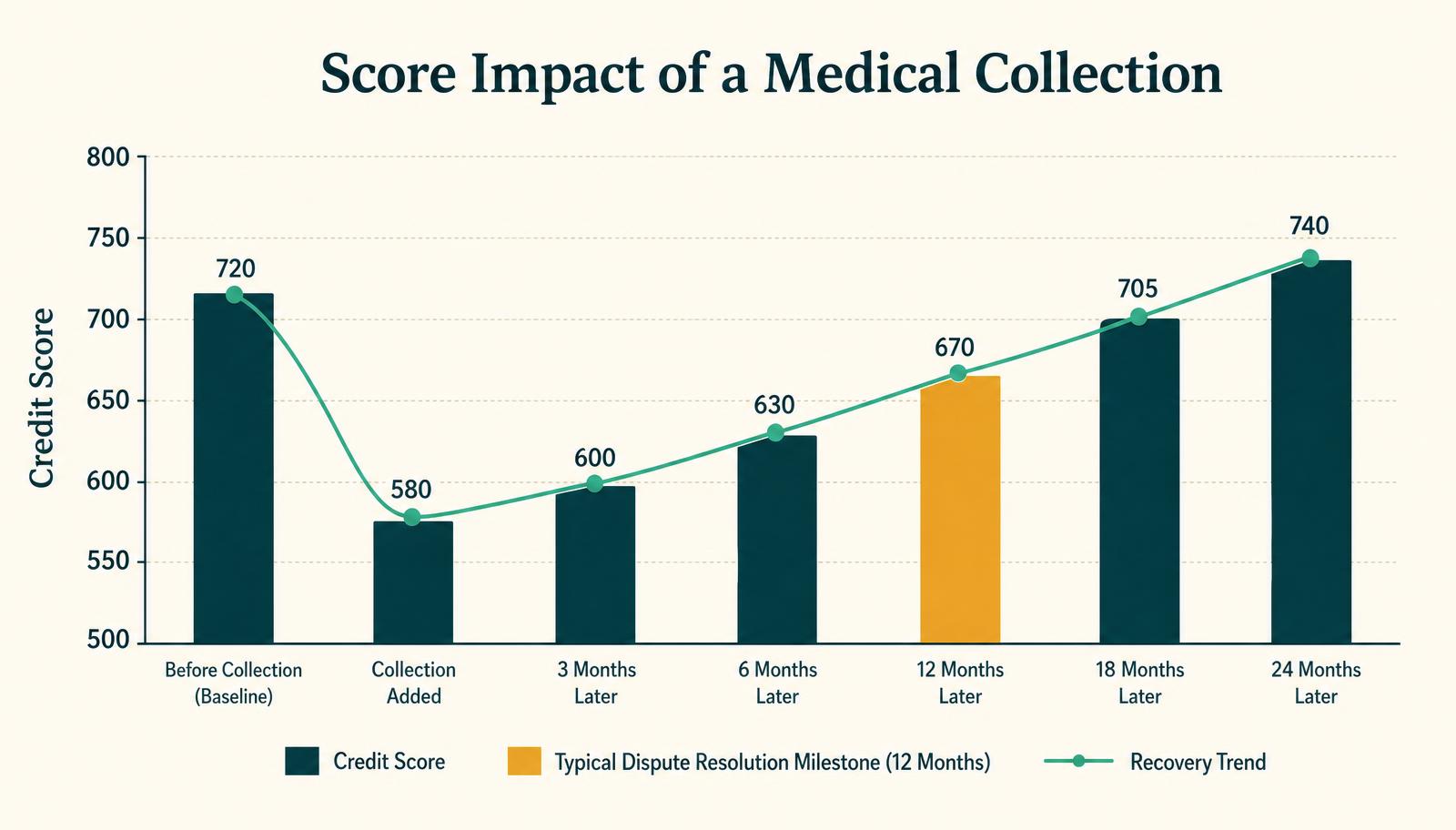
Scoring damage depends on your starting point, and the counterintuitive rule is that the higher your score, the more you lose. A consumer with a clean 720 file has further to fall than someone already at 580.
A realistic picture of what happens:
- A single new collection can cost 60 to 110 points on a previously clean file.
- The damage is front-loaded. Most of the drop happens the month the collection appears.
- Recovery starts almost immediately once the item is removed or paid, and once you add positive payment history.
- Newer scoring models are kinder. FICO 9, FICO 10T, and VantageScore 3.0 and 4.0 weigh medical collections less heavily than non-medical ones, and ignore paid collections entirely. Older FICO 8, still widely used in mortgage lending, does not make that distinction.
This is why the removal rules matter so much more than the scoring nuance. Getting the tradeline deleted beats hoping your lender uses a modern model.
Your 6-Step Action Plan for Medical Debt in 2026
Step 1: Pull All Three Credit Reports
You are entitled to free weekly reports from each bureau through AnnualCreditReport.com. Medical collections often appear on one bureau and not the others, so checking a single report is not enough. Read our full walkthrough on how to fix errors on your credit report before you start.
Step 2: Check Whether the Item Should Even Be There
For every medical collection you find, ask three questions:
- Has it been paid? If yes, it must come off.
- Is the unpaid balance under $500? If yes, it should not be listed.
- Is the date of first delinquency less than 12 months ago? If yes, it is too new to report.
A "yes" to any of these is a strong, factual dispute — not an opinion, not a plea for mercy.
Step 3: Demand an Itemized Bill Before You Pay Anything
Medical billing error rates are notoriously high. Duplicate charges, services never rendered, wrong billing codes, and insurance that was never applied are all routine. Request a fully itemized statement and compare it against your insurer's explanation of benefits line by line.

Step 4: Apply for Financial Assistance — Even Retroactively
Every nonprofit hospital in the United States is required to maintain a financial assistance (charity care) policy, and most people who qualify never apply because nobody tells them it exists. Many hospitals will approve assistance retroactively, even after a bill has gone to collections, and will then recall the account from the collection agency.

Ask the billing office directly:
- What is your financial assistance policy and income threshold?
- Can assistance be applied retroactively to this account?
- Will you recall the account from collections if assistance is approved?
- Do you offer a prompt-pay or self-pay discount?
- Can I set up a zero-interest payment plan instead of financing this?
Take the interest-free hospital payment plan over a medical credit card almost every time. The plan usually is not reported to the bureaus at all.
Step 5: Dispute in Writing, With Documentation
File your dispute directly with each bureau in writing and attach proof: the itemized bill, your explanation of benefits, the payment receipt, or the assistance approval letter. The bureau generally has 30 days to investigate. Keep copies of everything, and send anything critical by certified mail.
If a collector cannot validate the debt, it must come off. Send a written validation request within 30 days of first contact from the collector to trigger that obligation.
Step 6: Rebuild the Score Around It
While a dispute is pending, keep building positive history. On-time payments and low utilization do more for your score over six months than any single deletion. Our guides on improving your credit score fast and the best secured credit cards to rebuild credit cover the mechanics, and our Debt Management hub goes deeper on payoff strategy.
What Experts and Regulators Are Saying
Consumer advocates argue that medical debt is a poor predictor of creditworthiness, and lenders' own research has largely agreed — which is precisely why FICO and VantageScore began discounting it years before regulators acted. The counterargument from parts of the lending industry is that suppressing any repayment data reduces the accuracy of underwriting.
What both sides accept is the practical reality for consumers in 2026: the current protections are policy, not law. Policy can be revised. Treat every medical collection as something to resolve now rather than something that will resolve itself.
Real-World Impact: Why This Reaches Beyond Your Score
A medical collection is rarely just a number. It shows up as:
- Higher borrowing costs. The gap between a 620 and a 720 score on a 30-year mortgage can exceed six figures in lifetime interest.
- Housing denials. Many landlords screen credit and reject applicants with collections.
- Employment and licensing friction. Some roles run credit checks as part of background screening.
- Insurance premiums. In most states, credit-based insurance scores affect auto and home rates.
- Delayed care. Studies consistently find people skip needed treatment because they fear the billing consequences — the most expensive outcome of all.
Common Mistakes to Avoid
- Paying a collector before validating the debt. Once you pay, your leverage is gone.
- Moving medical debt onto a credit card. This strips away every medical-specific protection.
- Ignoring the 12-month window. That grace period is your best chance to fix billing errors before anything is ever reported.
- Accepting the first bill as final. Prices are negotiable, and assistance programs are real.
- Paying a credit repair firm. Everything in this guide you can do yourself for free.
- Assuming the headlines applied to you. Many people believe their medical debt was already wiped. Verify it on all three reports.
Quick Summary
There is no federal ban on medical debt in credit reports in 2026. What remains is a voluntary policy from all three bureaus that keeps paid medical collections, unpaid balances under $500, and debt under 12 months old off your consumer report. Anything outside those categories can still be reported and can cost you 60 to 110 points. Your playbook: pull all three reports, verify whether the item qualifies for exclusion, demand itemized billing, apply for hospital financial assistance, dispute in writing with documentation, and keep building positive payment history while you wait.
Conclusion and Future Outlook
The medical debt fight is not over. Expect continued state-level legislation, further appeals and rulemaking at the federal level, and continued movement by the scoring companies toward discounting medical collections. But none of that is guaranteed, and none of it is fast.
What is entirely within your control is the next 30 days. Pull your reports, find out whether a medical collection is sitting on your file, and start the process of removing it. People do this successfully every day, without a lawyer and without paying anyone.
Start with our Credit Reports & Scores hub for the underlying mechanics, then follow the step-by-step rebuilding roadmap to turn a cleaned-up report into a genuinely strong score.
Want the complete system in one place? Grab The Honest Credit Rebuild Blueprint — our full step-by-step guide to disputing errors, negotiating balances, and rebuilding your score from the ground up. For a limited time, save 40% at checkout.
Has a medical bill ever hit your credit report? Leave a comment with what worked for you, and share this guide with someone who is staring at a hospital statement right now.
Authoritative sources: the Consumer Financial Protection Bureau publishes official guidance on medical debt collection and credit reporting, the Federal Trade Commission explains your dispute rights under the Fair Credit Reporting Act, and MyFICO documents how collections are treated across scoring models.