
Carrying a credit card balance in 2026 is expensive in a way that compounds quietly. At a typical rate in the low twenties, a $6,000 balance paid down with minimum payments takes well over a decade and costs more in interest than the original purchases. A balance transfer credit card interrupts that math by moving the debt to a card that charges nothing for a fixed introductory window.
Used properly, it is one of the most powerful debt tools available to an ordinary consumer. Used carelessly, it is a way to feel productive while the balance stays exactly where it was.
Why This Matters Right Now
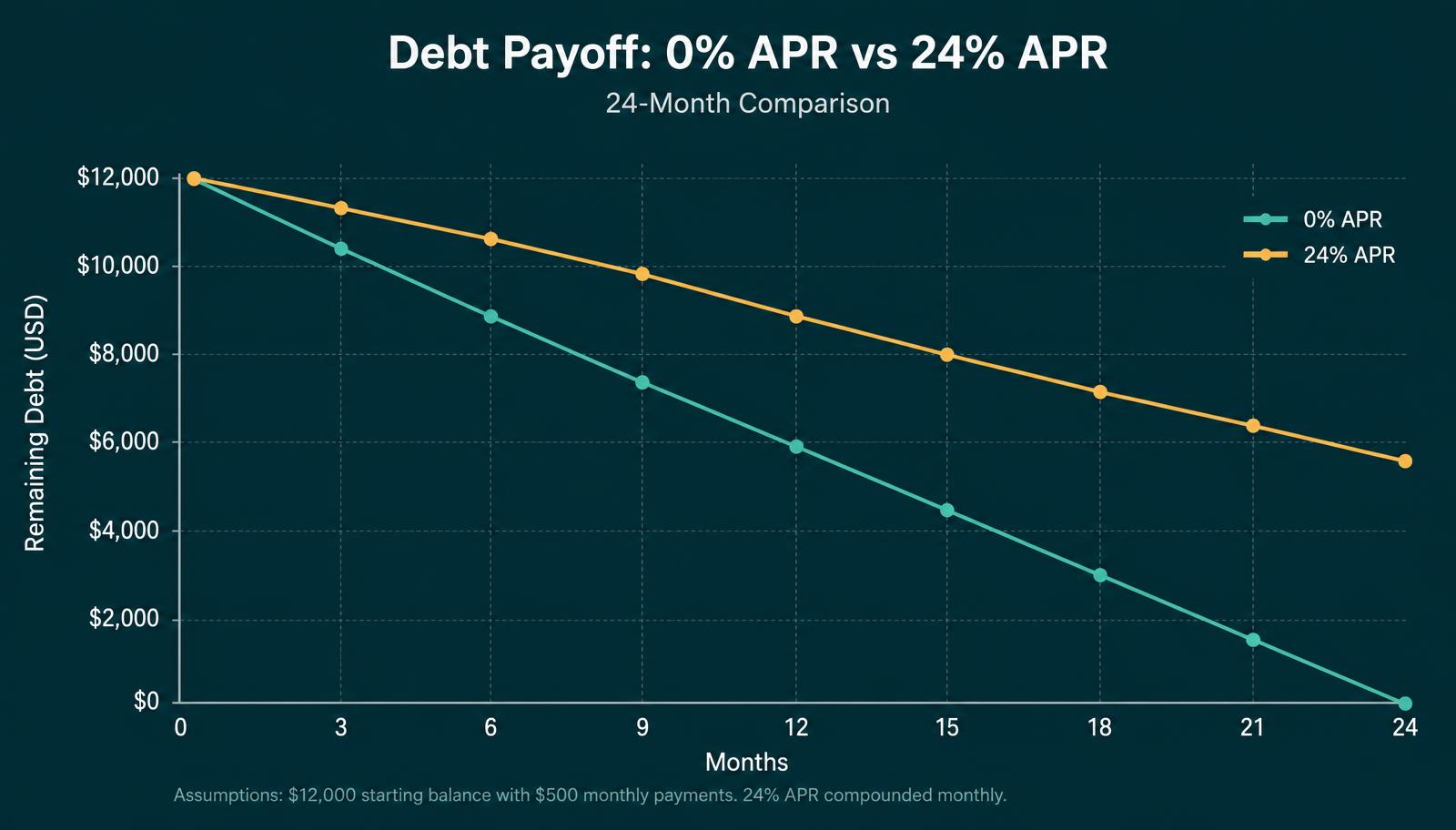
Revolving balances are at record highs, and average card APRs have stayed stubbornly elevated even as other rates moved. For a household paying 24% on five figures of card debt, interest alone can consume several hundred dollars a month before a single dollar touches principal.
That is the trap: minimum payments are engineered to keep you in it. A balance transfer breaks the loop by removing interest from the equation for 12 to 21 months, which is usually long enough to finish the job if the payments are sized correctly.
Background: How a Balance Transfer Actually Works
- You apply for a card from a bank you do not already owe money to.
- On approval you request a transfer of some or all of an existing balance, up to the new card's limit.
- The new issuer pays the old one directly, typically within a week or two.
- A transfer fee — usually 3% to 5% of the amount moved — is added to your new balance.
- The 0% clock starts on the transfer date, not on the day you finally get around to paying attention.
Keep paying the old card until you confirm the transfer has posted. Transfers are not instant, and a missed payment during the handover undoes the benefit.
The only calculation that matters
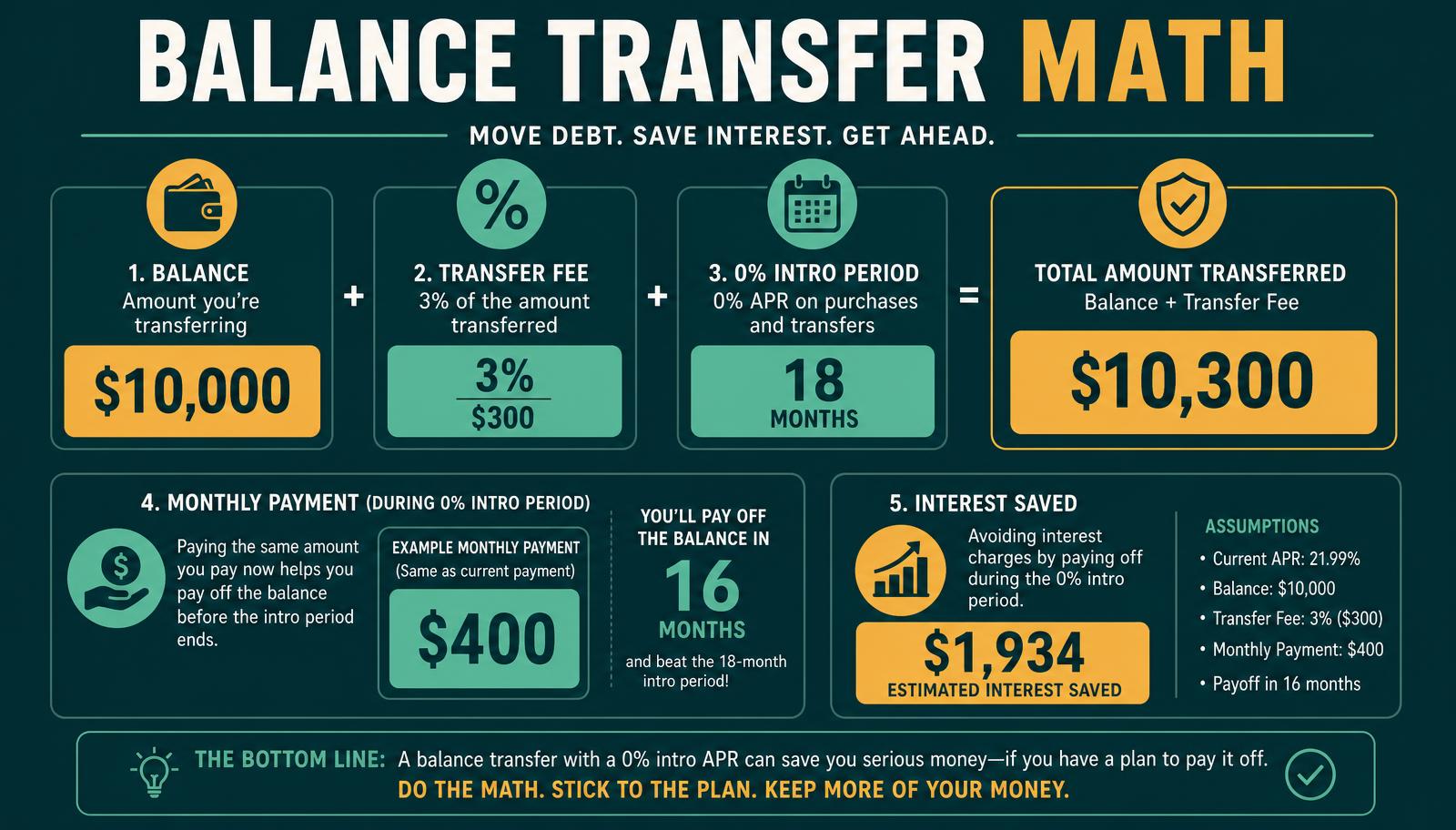
Take the balance, add the transfer fee, divide by the number of intro months. That number is your monthly payment. If you cannot afford it, the card will not fix your problem on its own — you need a smaller transfer, a longer intro period, or a different strategy entirely.
Example: $6,000 balance, 3% fee, 18-month intro.
- Fee: $180. New balance: $6,180.
- Required payment: $6,180 ÷ 18 = $344 per month.
- Interest avoided at 24% APR: roughly $1,300.
- Net saving: about $1,120, plus finishing years earlier.
Key Facts and Data
- Typical intro periods run 12 to 21 months; the longest offers usually require strong credit.
- Transfer fees are commonly 3%, sometimes 5%, and occasionally waived for transfers made within the first 60 days.
- Approval for the best offers generally needs a score in the good to excellent range — roughly 690 and above.
- Most cards do not extend the 0% rate to new purchases. Assume purchases accrue interest immediately unless the offer says otherwise.
- Issuers often cap the transferable amount, either at a fixed dollar figure or at a share of your new credit limit.
- Missing a payment can void the promotional rate entirely under the card agreement.
Who Should — and Should Not — Use One
A balance transfer fits if:
- Your score is high enough to qualify for a meaningful intro period.
- The balance is payable within that window at a payment you can actually sustain.
- The spending that created the debt has already stopped.
Look elsewhere if:
- Your credit is currently too damaged to qualify. Rebuild first — our fast-track score guide is the place to start.
- The balance is so large that the required monthly payment is unrealistic. A personal loan with a longer term, or a nonprofit credit counselling plan, may fit better.
- You expect to keep charging on the cards you just cleared. A transfer without a behaviour change simply doubles the available credit.

The Fine Print That Costs People Money
- Deferred interest is not the same as 0% APR. True balance transfer offers waive interest during the intro period permanently. Deferred-interest promotions, more common in store financing, retroactively charge every dollar of interest if any balance remains at the end. Read which one you have.
- Payment allocation. Issuers must apply amounts above the minimum to the highest-APR balance first, which is why mixing purchases with a transferred balance is messy.
- The transfer window. Most cards only honour the promotional fee and rate for transfers completed within the first 60 days.
- Late payment penalties. One late payment can end the promotion and trigger a penalty APR.
- Second transfers. Moving the same debt again at the end of the intro period is possible, but each move costs another fee and another hard inquiry — and approval is not guaranteed.
What It Does to Your Credit Score
The short-term effects are minor; the medium-term effects are usually positive.
- Hard inquiry: a few points, recovering within months.
- New account: lowers your average age of accounts slightly.
- Utilization: this is the big one. Adding a new credit limit while the total debt stays flat lowers your overall utilization immediately, and paying it down drives it lower still. The mechanics are explained in our credit utilization guide.
- Closing the old card: avoid it. Closing removes that limit from the utilization calculation and can undo the entire benefit.
For anyone preparing to buy a home, sequencing matters — read the 2026 mortgage credit score rules before opening new accounts within a year of applying.

A Six-Step Execution Plan
- Total the debt. Every card, every balance, every APR. No estimates.
- Check pre-qualification offers that use a soft pull before formally applying.
- Apply for one card, not three. Multiple applications in a week look like distress.
- Transfer within the first 60 days to lock the promotional fee and rate.
- Set autopay for the balance-divided-by-months figure, scheduled the day after payday.
- Freeze the old cards — literally put them in a drawer — and leave the accounts open.
Then set a calendar reminder for two months before the intro period ends. If a balance remains, you will want time to plan rather than discover it in a statement.
Real-World Impact
The obvious benefit is the interest saved. The less obvious one is momentum. When every payment visibly reduces the balance, people keep going; when two-thirds of each payment vanishes into interest, they quit. Behavioural research on debt payoff has repeatedly found that visible progress is what sustains the effort.
There is also a knock-on credit benefit. Falling utilization is the fastest-moving lever in scoring models, and borrowers who clear a large card balance frequently see double-digit score gains within one or two statement cycles — which in turn lowers the cost of every future loan.
For neutral comparison of card terms and your rights as a cardholder, the Consumer Financial Protection Bureau's credit card resources are the best starting point, and the Federal Trade Commission's guidance on getting out of debt covers the alternatives if a transfer is not the right fit.
Key Takeaways
- A balance transfer buys time, not forgiveness — the payoff plan is the product.
- Divide the balance plus fee by the intro months and automate that payment.
- Compare the 3–5% fee against the interest you would otherwise pay; it usually wins.
- Keep the old accounts open to protect your utilization ratio.
- Stop charging. A transfer without a behaviour change just enlarges the problem.
Conclusion and Outlook
Card rates are unlikely to fall far or fast, which makes the 0% window one of the few genuine discounts left in consumer credit. Treat it as a deadline rather than a reprieve: calculate the payment, automate it, and put the cards away until the balance hits zero.
If your score is not there yet, build first and transfer later — our secured card roundup and credit-builder loan guide are the two fastest on-ramps.
Want the full debt payoff system? The Honest Credit Rebuild Blueprint includes the payoff calculator and negotiation scripts — currently 40% off.