
Most credit products have the same problem for anyone starting out: you need credit to get credit. A credit builder loan solves that by running the transaction backwards. The lender approves you, then locks the money away and hands it over only after you have made every payment.
You are, in effect, paying yourself on an installment schedule — and generating a clean 12-month payment history in the process. For people with a thin file, a rebuilt-from-zero file after bankruptcy, or no U.S. credit history at all, it is one of the few tools that reliably works.
Why This Matters Right Now
Tens of millions of American adults are credit invisible or unscoreable — they have no credit file, or too little in it to generate a score. That is not a character judgment; it is a data problem. Cash-and-debit households, recent immigrants, young adults and people who wiped the slate clean through bankruptcy all end up in the same bucket.
The cost of being invisible keeps rising. Landlords, insurers, utilities and employers all pull credit data. Without a score, the answer is frequently a larger deposit, a co-signer requirement, or a flat no.
Background: How the Product Works
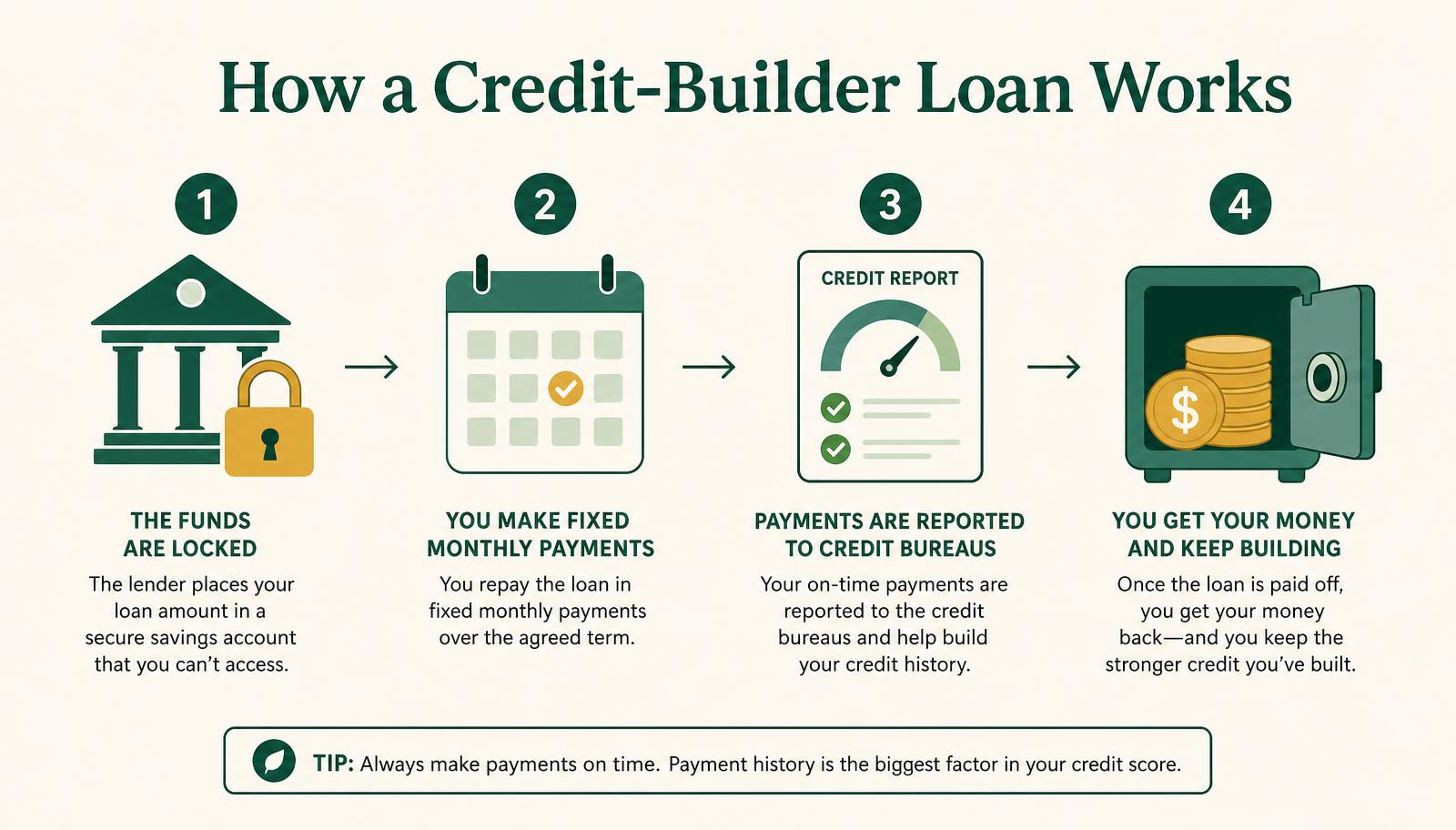
The mechanics are simple and deliberately low-risk for the lender.
- You apply for a small loan, typically $300 to $1,500, over 6 to 24 months.
- The funds are locked in a savings account or certificate you cannot touch.
- You make fixed monthly payments, each reported to Equifax, Experian and TransUnion.
- At the end of the term the account unlocks and the money is yours, minus interest and any administration fee. Some lenders refund part of the interest.
Because the collateral is the loan itself, the lender is barely exposed — which is why approval usually does not require a good score, and often requires no hard credit inquiry at all.
What it does to your credit file
- Payment history. Twelve on-time payments in the largest scoring factor.
- Credit mix. Adds an installment account, worth roughly 10% of a FICO score, and especially valuable if you only have credit cards.
- Account age. Starts a clock that keeps paying off for years.
- No utilization damage. Installment balances are not treated like revolving balances, so a credit-builder loan does not drag on the utilization factor discussed in our utilization guide.
Key Facts and Data
- Typical loan size: $300–$1,500. Typical term: 6–24 months.
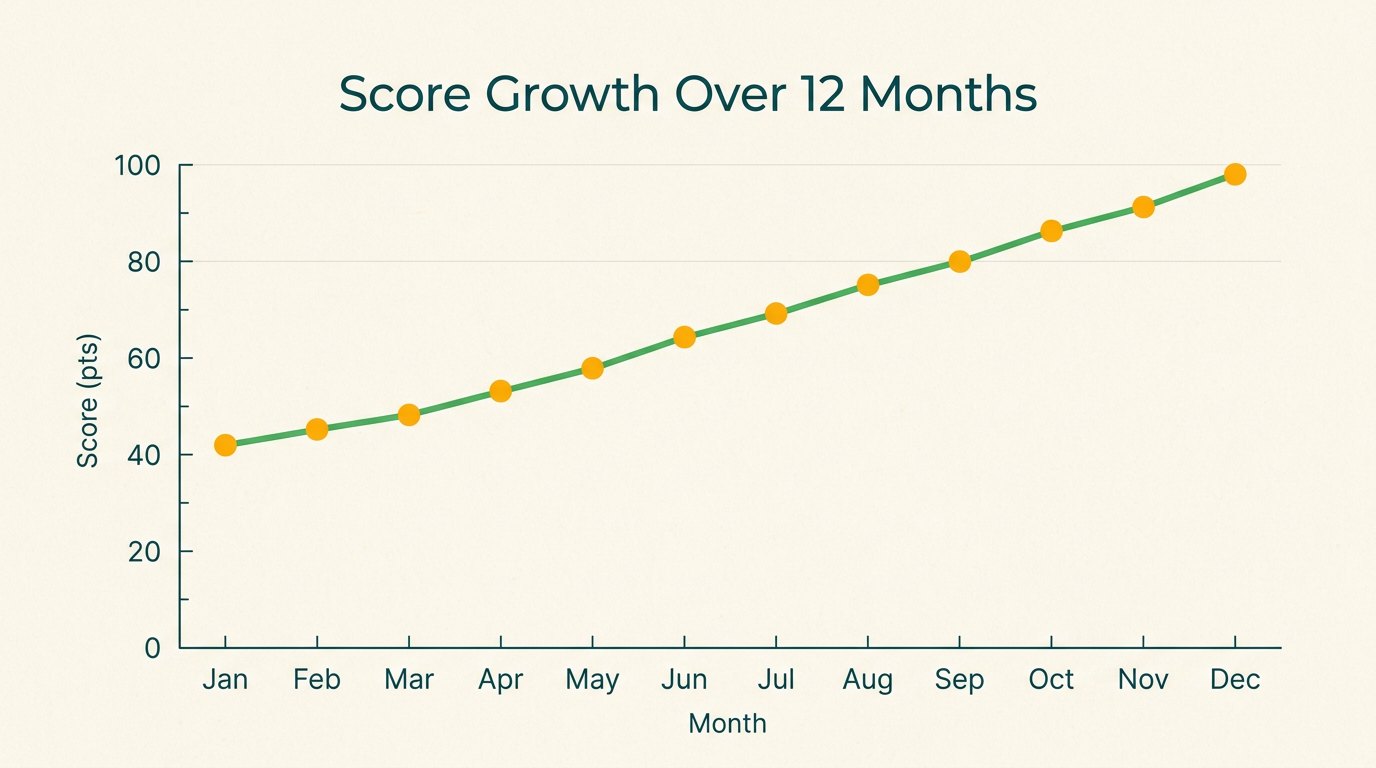
- Consumer research has repeatedly found the strongest results for borrowers with no other open installment loans, with average gains around 60 points.
- Borrowers with existing debt see smaller effects, and those who miss payments can end up worse off than when they started.
- Many credit unions offer these at low single-digit APRs; fintech products vary widely, and a flat monthly fee can translate into a much higher effective cost than the advertised rate.
- Some providers report a paid-off loan for the full seven to ten years it remains on file, extending the benefit long after the term ends.
How to Choose a Credit-Builder Loan
Not all of them are worth signing. Run every offer through this checklist.
- Does it report to all three bureaus? If the answer is one bureau, or "we report to our partner," walk away. This is the only reason to take the product.
- What is the total cost? Add interest plus every fee, then compare that number against the credit benefit. Paying $60 for a year of installment history can be reasonable; paying $300 is not.
- Is there an administration or setup fee? Common, but it should be small and disclosed clearly.
- What happens if you miss a payment? Ask specifically whether late payments are reported and what the grace period is.
- Is the payment automatable? Autopay from a checking account you control is non-negotiable.
- Who is the lender? Federally insured credit unions and community banks are typically the cheapest source; many will open one for a member with no credit history at all.

Credit-Builder Loan vs. Secured Credit Card
These are complements, not competitors.
| Feature | Credit-builder loan | Secured credit card |
|---|---|---|
| Account type | Installment | Revolving |
| Money up front | No | Yes, as a deposit |
| Builds credit mix | Yes | Only if you lack cards |
| Affects utilization | No | Yes |
| Forced savings | Yes | Deposit is returned |
| Best for | No installment history | No revolving history |
If your file is genuinely empty, running one of each for twelve months covers both categories at once. Our roundup of the best secured credit cards for rebuilding credit pairs naturally with this guide.
Mistakes That Waste the Whole Year
- Missing a payment. One 30-day late can erase a year of gains. Automate it and keep a buffer in the account.
- Taking a term that is too long. Twelve months is usually enough. A 24-month term means more interest for the same signal.
- Choosing a lender that reports to one bureau. Confirm it in writing before signing.
- Borrowing more than the budget allows. The payment must be boring. If it is tight, it will eventually be late.
- Opening several at once. One is a credit builder; three are a debt problem.
- Ignoring the rest of the file. A credit-builder loan will not outrun an unpaid collection account or a report full of errors.
Real-World Impact
The practical payoff is rarely the score itself — it is what the score unlocks. A tenant who becomes scoreable stops paying double deposits. A driver with a 640 instead of no score can finance a reliable car at a rate that does not consume the budget. And because the product forces savings, borrowers often finish with their first meaningful emergency fund, which is the thing that prevents the next missed payment.
Regulators have taken an interest too. The Consumer Financial Protection Bureau's research on credit-builder loans is the clearest public evidence that they work — with the important caveat that they help most when the borrower has no other debt to service.

Quick Summary
- A credit-builder loan locks the funds and pays you at the end.
- Approval rarely depends on your score, and often involves no hard pull.
- Biggest gains go to people with no existing installment loans.
- Confirm three-bureau reporting before signing anything.
- Pair it with a secured card to cover both installment and revolving history.
- One missed payment can undo the entire year.
Conclusion and Outlook
Credit-builder loans are not glamorous and they are not fast. What they are is dependable: a structured, low-risk way to manufacture the one thing a thin file lacks, while quietly building savings on the side.
Pick a credit union first, keep the payment small enough to be boring, automate it, and let twelve months do the work. Then check your progress with our fast-track guide to improving your credit score.
Ready to build the full plan? The Honest Credit Rebuild Blueprint lays out the complete 12-month rebuilding system and is currently 40% off.