
Six years ago, splitting a $180 pair of sneakers into four $45 payments was a financial ghost. It did not appear on your credit report, it did not affect your score, and no lender ever saw it. That era is over. In 2026, buy now, pay later credit score effects are real, measurable, and showing up in credit files across the country — for better and for worse.
If you have ever tapped "Pay in 4" at checkout, this guide explains exactly what changed, how those installments are being scored, and how to make BNPL work for your credit instead of against it.
Why This Matters Right Now
Buy now, pay later exploded from a niche checkout button into mainstream credit. Tens of millions of American shoppers use it, and a large share of those users are exactly the people with the most to lose: young borrowers, thin-file consumers, and anyone actively rebuilding after a rough financial stretch.
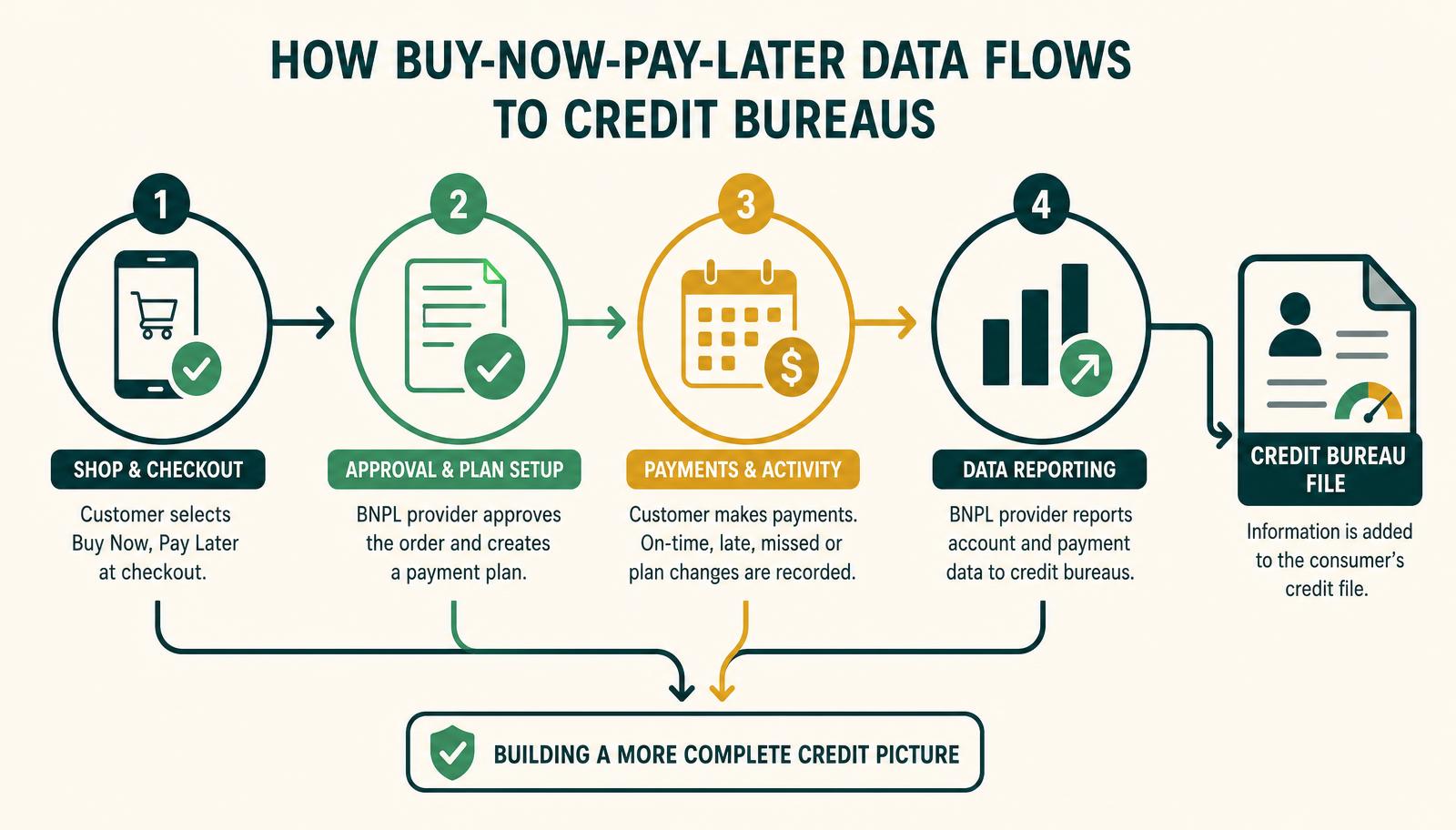
For years the industry's defining feature was invisibility. Providers largely did not report to Equifax, Experian, or TransUnion. That created a strange blind spot — a shopper could be juggling six active plans while their credit report showed nothing at all.
That blind spot is closing. The bureaus have built the infrastructure to accept BNPL data, the scoring companies have studied how to treat it, and providers have started furnishing account information. The practical result: your installment behavior is becoming part of your permanent credit story.
Background: What BNPL Actually Is
Strip away the branding and BNPL is a short-term installment loan.
- Pay-in-four: the classic version. One purchase, four equal payments, typically every two weeks, usually with no interest if you pay on time.
- Monthly financing: longer terms — six, 12, 24, or even 36 months — often with interest, and functionally similar to a personal loan.
- BNPL cards and virtual cards: a hybrid that lets you split purchases at merchants that do not offer BNPL natively.
The distinction matters for your credit. Pay-in-four plans are tiny and close within weeks. Monthly financing looks much more like traditional credit, and it is far more likely to involve a hard inquiry and full bureau reporting from day one.
The Three Things Lenders Never Used to See
- How many plans you have open. Five simultaneous plans is a very different risk profile than one.
- Whether you pay on time. The single most predictive signal in all of consumer credit.
- How much of your income is already committed. Underwriters call this debt-to-income; BNPL used to be missing from the math entirely.
How BNPL Is Scored
Credit scoring is not a mystery box. FICO's model weighting has been public for years, and the same factors apply once BNPL data lands in your file.
| Scoring factor | Approximate weight | How BNPL interacts |
|---|---|---|
| Payment history | ~35% | On-time installments help; a 30-day late is a serious negative |
| Amounts owed | ~30% | BNPL is installment debt, so it does not raise card utilization |
| Length of credit history | ~15% | Short plans can drag down average account age |
| Credit mix | ~10% | Minor positive — installment debt alongside revolving |
| New credit | ~10% | Frequent new plans can look like credit-seeking behavior |
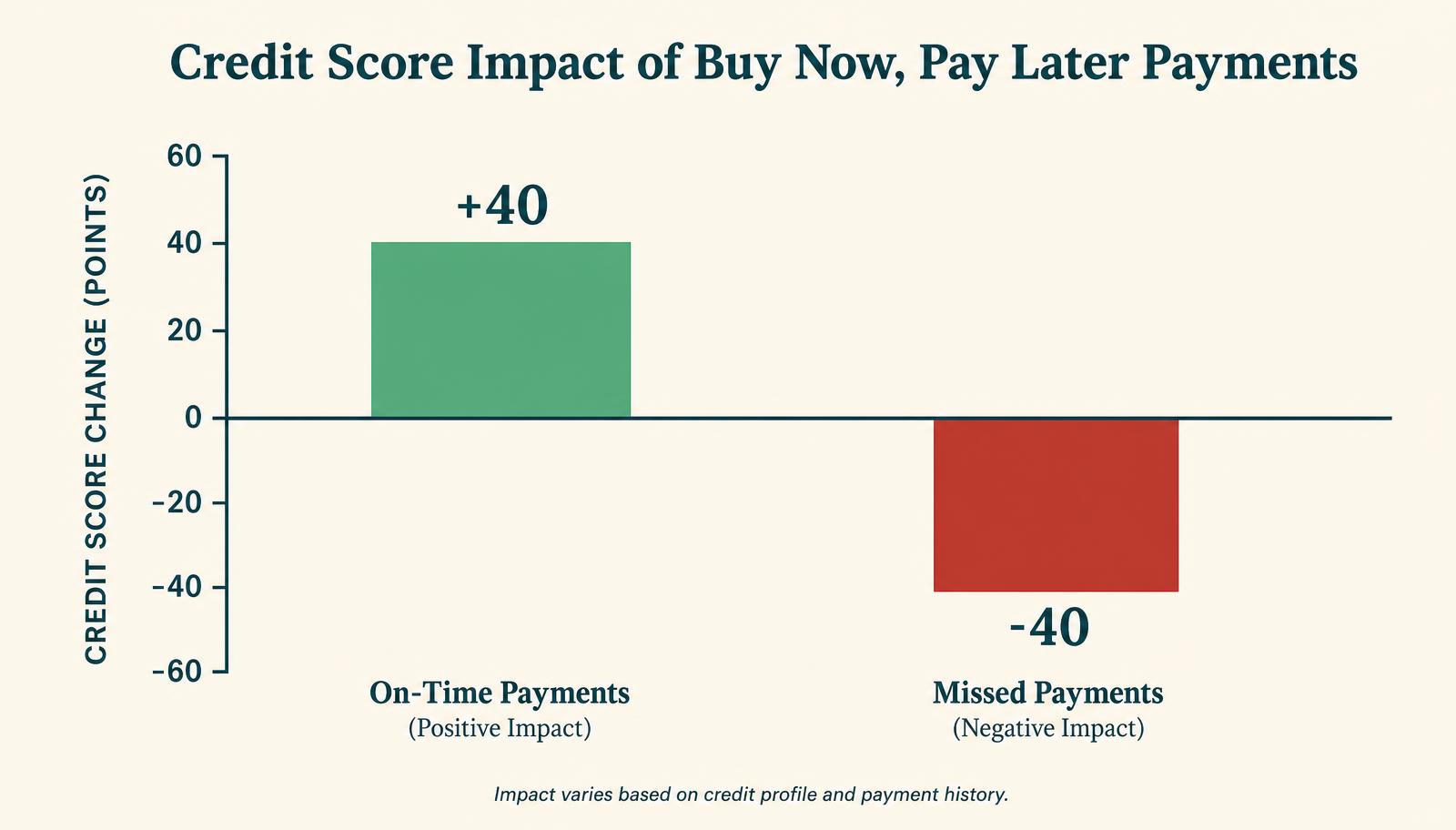
The asymmetry is the part most people miss. The upside of an on-time BNPL plan is small and gradual. The downside of a missed one is immediate and steep — especially if your file is thin, because a single derogatory item carries enormous weight when there is little positive history to offset it.
The Real-World Impact
For Thin-File and Rebuilding Borrowers
This is the group most affected. If you are working through the steps in our step-by-step guide to rebuilding credit after bankruptcy, a reported BNPL delinquency can undo months of careful progress in a single billing cycle.
The flip side is genuinely encouraging: consistent, reported on-time installments give a thin file something it desperately needs — evidence of repayment.
For Mortgage and Auto Applicants
Underwriters now see obligations that were previously hidden. Four active plans totaling $900 in remaining payments will show up in your debt-to-income calculation. That can shift a borderline approval, or shrink the loan amount you qualify for.
Practical rule: clear open BNPL plans before you apply for a mortgage or car loan, not during.
For Everyone Else
Even people with strong credit should care, because BNPL friction is real. Multiple due dates across multiple apps, each with its own auto-pay setup and card on file, is a recipe for one payment slipping through — and a slipped payment now has consequences it did not have before.
The Five Mistakes That Cost People Points
- Stacking plans. Each purchase creates a separate obligation. Three plans means three chances to miss a payment.
- Linking a debit card with a thin balance. A failed auto-payment on a nearly empty account becomes a late payment plus an overdraft fee.
- Assuming "no credit check" means "no credit impact." A soft check at approval says nothing about whether the account gets reported afterward.
- Paying BNPL with a credit card. You convert an interest-free installment into revolving debt at 20%-plus, and you push up your utilization.
- Ignoring collections notices. An unpaid BNPL balance can be sold to a collector, and a collection account is one of the most damaging items a report can carry.
How to Use BNPL Without Hurting Your Score

One plan at a time. This single rule eliminates most BNPL risk. If a second purchase cannot wait until the first plan closes, it is a signal the purchase is not affordable yet.
Write every due date in one place. A phone calendar entry per installment, or a single notebook page. The apps will not coordinate with each other, so you have to.
Fund the auto-pay account deliberately. Move the full installment amount into the linked account the day you buy, not the day it is due.
Cap total BNPL exposure. A useful ceiling: no more than 5% of your monthly take-home pay committed to installments at any time.
Choose the payment method carefully. Debit from a funded account beats a credit card almost every time.
Pull your reports. You are entitled to free weekly reports from all three bureaus at AnnualCreditReport.com, the only federally authorized source. Look for BNPL tradelines and confirm the balances, dates, and statuses are accurate.

What Experts and Regulators Emphasize
Consumer advocates and regulators have converged on a consistent message: BNPL is credit, and it should be treated with the same seriousness as a credit card. The Consumer Financial Protection Bureau has documented the industry's growth and the pattern of repeat and simultaneous borrowing that drives most of the harm. The Federal Trade Commission stresses that your dispute rights under the Fair Credit Reporting Act apply to BNPL tradelines just as they do to any other account, and MyFICO documents how installment payment history feeds the models.
The recurring theme in the data is not interest rates. It is stacking — the accumulation of several small plans that individually feel trivial and collectively become unmanageable.
Quick Summary
Buy now, pay later has moved out of the credit-reporting shadows. Plans are increasingly furnished to the bureaus, which means on-time installments can add positive payment history while late payments can create real, lasting damage. The scoring upside is modest because the loans are small and short. The downside is not modest at all. Run one plan at a time, keep every due date in one place, fund the linked account in advance, never pay BNPL with a credit card, and check all three reports so you know exactly what lenders see.
Conclusion and Future Outlook
Expect BNPL reporting to become the norm rather than the exception, and expect scoring models to get better at distinguishing responsible single-plan use from high-risk stacking. That is ultimately good news for careful borrowers: behavior that used to earn no credit will finally count for something.
Until the models settle, treat every installment plan like a loan on your credit report — because that is increasingly what it is. Start with our Credit Basics hub to understand the scoring fundamentals, then use the fast-track guide to improving your credit score to put those points to work. If a BNPL account has already been sold to a collector, our guide to fixing errors on your credit report walks through the dispute process line by line.
Want the complete system in one place? Grab The Honest Credit Rebuild Blueprint — our full step-by-step guide to repairing your report, rebuilding your score, and reclaiming your financial freedom. For a limited time, save 40% at checkout.
Do you use buy now, pay later? Leave a comment with how you keep the due dates straight, and share this guide with a friend who is juggling three plans right now.
Authoritative sources: the Consumer Financial Protection Bureau publishes research on BNPL lending and consumer risk, the Federal Trade Commission explains your credit reporting rights, and MyFICO documents how payment history and new credit are scored.